Why Most Lovable AEO Setups Get Ignored by AI Search Engines
AIFun Agency's Lovable audits reveal a recurring pattern: polished UIs and fast pages still get zero AI citations. Here's what answer engines actually look for on Lovable sites.
A regional financial planning firm rebuilt its site on Lovable. The design was clean. The pages loaded fast. The content read well. Then someone typed "which financial planner near me is best for retirement planning" into Perplexity AI. The answer cited a competitor’s blog post from 2026. That Lovable site never appeared. This is the quiet failure mode of most Lovable AEO implementations: the site exists, but answer engines treat it as decorative rather than citable.
What Does AEO Actually Mean for a Lovable Website in 2026?
AEO—answer engine optimization—means making a Lovable site extractable, quotable, and recommendable by AI search tools like ChatGPT, Perplexity AI, Google AI Overviews, Gemini, and Bing AI Copilot. It is not a replacement for traditional Google SEO. It is a second discipline built on machine-readable answer structure, entity clarity, and stable rendering, and it matters more for Lovable sites because they ship as JavaScript applications.
Traditional SEO still rewards links, authority, and keyword relevance. AEO rewards something narrower: can an AI system pull a direct, accurate answer from a page without confusion or rendering friction? According to Google Search Central, JavaScript-heavy pages often require additional crawling passes before content becomes visible, which changes how Google and other AI-driven surfaces consume a Lovable site. For answer engines, the unit of competition is not only the ranking position. It is the cleanly extractable answer block, the entity signal, and the speed at which a crawler can trust what it sees.
Lovable sites are built for visual product speed. That is an advantage for humans. It becomes a liability for machines when the content lives only inside hydrated client-side components. A Lovable AEO setup must therefore reposition the same pages into a format that AI crawlers can parse without executing a full browser session.
Why Does a Lovable Site Look Invisible to ChatGPT and Perplexity?
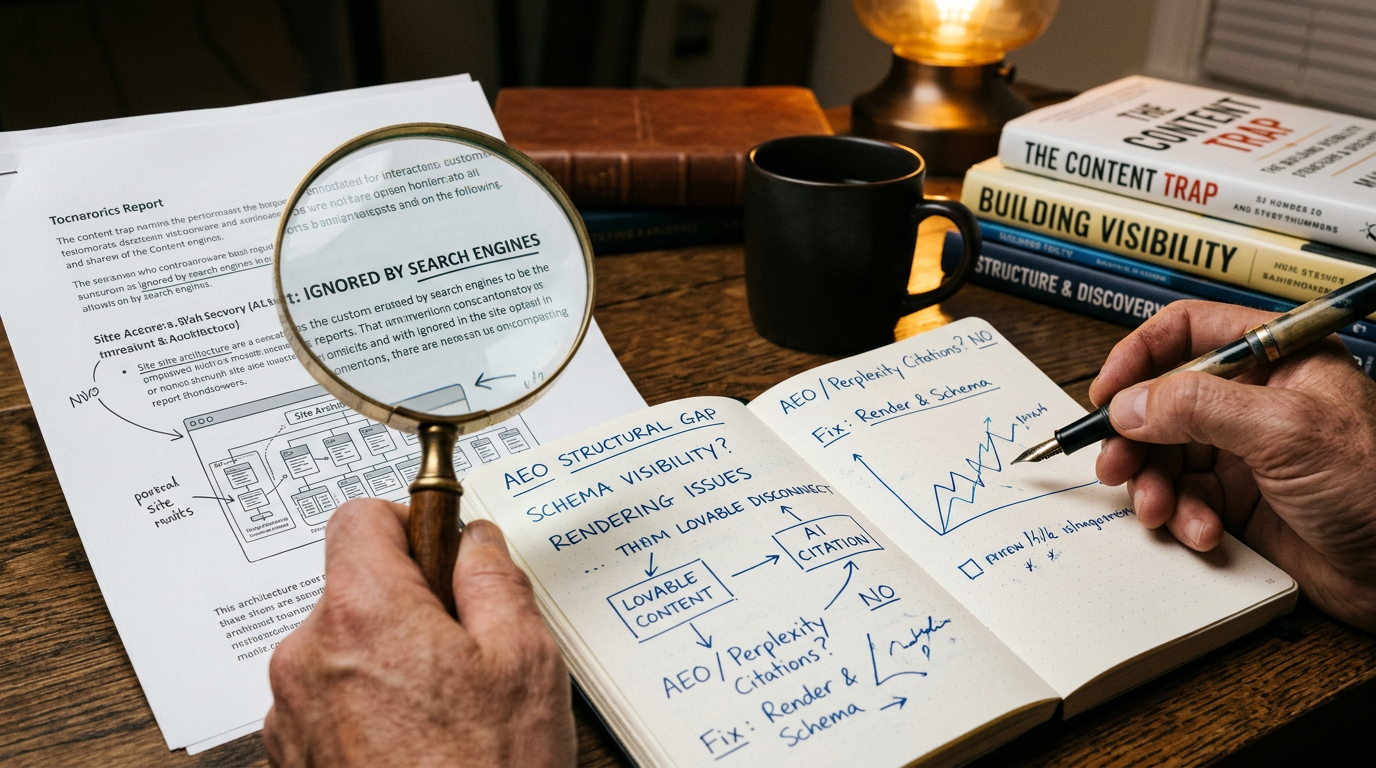
A Lovable site often looks invisible to ChatGPT and Perplexity because the content is rendered too late for the crawler that samples the page. Client-side rendering returns an empty or near-empty HTML shell, and AI engines often truncate or skip content that arrives after the initial fetch. Without llms.txt or schema markup, those systems also lack a clear map to the most important answer pages.
The issue begins with Lovable's architecture. Lovable builds on TanStack Start and often pulls dynamic content from Supabase. When a crawler requests a URL, the initial HTML may contain only the app shell. The real text, headings, and answer content appear after JavaScript executes. If a crawler does not execute JavaScript fully, it sees little worth citing. OpenAI's introduction of ChatGPT search reinforced that the web is sampled through a mix of crawl, retrieval, and real-time lookup; if a page returns an empty shell first, the retrieval layer rarely revisits it.
Templates add another layer. Many Lovable starting points prioritize visual polish over extractable structured content. Hero sections, animations, and componentized storytelling look impressive to a human visitor, but they often bury the answer under layers of UI that offer no clean quote boundary. AI engines prefer pages that can be quoted without formatting overhead. That is why a beautiful Lovable marketing page can lose to a plain HTML competitor page with one clearly stated answer.
Where Do Most Lovable AEO Setups Go Wrong?
Most Lovable AEO setups go wrong because they treat AEO as a one-time plugin or a single prompt task instead of an ongoing content architecture practice. They publish one polished page instead of a network of answer-focused pages. And they rely on Supabase data that is not pre-rendered before crawler access, which leaves the site structurally mute to AI retrieval systems.
The typical sequence is common. A team builds a Lovable site, installs a chatbot widget, adds a few meta tags, and then expects AI engines to start recommending the business. That is not AEO. That is branded decoration. AEO requires query fan-out pages, stable URL structures, schema markup, and explicit content rules that tell large language models how to use the site. It also requires server-side rendering or prerendering for the pages that matter commercially.
Another recurring mistake is skipping the answer capsule format. On a Lovable page, the answer should appear immediately after the headline, in two or three plain sentences, before any visual flourishes or deeper commentary. When that capsule is missing, the AI crawler has to infer the answer from scattered paragraphs. It rarely bothers.
How Does Client-Side Rendering Tank AI Visibility on Lovable?
Client-side rendering tanks AI visibility on Lovable because JavaScript-heavy pages may return empty HTML to crawlers that do not execute JavaScript fully. Google Search Central recommends server-side rendering or prerendering for dynamic content, and AI search engines often skip or truncate content that arrives too late. The result is that a Lovable page can be fast for humans and effectively blank for machines.
Lovable marketing routes are especially exposed. Product and blog pages built as client-side components often depend on Supabase queries and TanStack Start hydration before text appears. Some AI crawlers and search bots do execute JavaScript. But their timeout budgets are small, and their rendering queues are unpredictable. A page that takes several seconds to hydrate can simply be abandoned.
Prerender.io and similar services can bridge the gap for Lovable marketing routes. They serve static HTML snapshots to crawlers while human visitors still receive the full client-side experience. The trade-off is operational: snapshots must be refreshed when content changes, and dynamic user-specific pages should not be prerendered. But for answer-focused pages, prerendering transforms a silent Lovable site into a citable source almost immediately. A dedicated server-side rendering for Lovable AI search setup remains the stronger foundation.
Which Lovable Features Need to Be Repositioned for Answer Engines?
Lovable's custom domains, clean routing, and component architecture can support AEO when repositioned for machine readability. Custom domains create stable, citable URLs. Clear entity mentions in page headers improve context for large language models. And Supabase-backed content should be mirrored in static or server-rendered sections so crawlers see text without waiting for hydration.
The same Lovable components that create polished UI can also produce answer capsules. A page hero can include a two-sentence direct answer below the H1. A services page can list the business name, category, city, and core offer in plain text near the top. Small structural decisions like those make the difference between a page that looks impressive and a page that answers a question.
Entity clarity matters here. AI engines use named entities to understand who the business is and what it offers. A Lovable site should consistently mention the business name, service category, and location in predictable places. That consistency helps ChatGPT, Perplexity AI, and Google AI Overviews anchor the page to relevant queries. Lovable documentation covers custom domains and routing, but the AEO layer is the publisher's responsibility.
What Does Query Fan-Out Look Like on a Lovable AEO Setup?
Query fan-out means creating a separate Lovable page for each question a buyer is likely to ask an AI search tool. Each page begins with a standalone answer capsule, then expands into supporting detail, examples, and local context. Lovable makes it relatively easy to generate and manage many of these pages because the component system can repeat a consistent answer-first layout.
A local HVAC company should not publish one "heating services" page and expect AI recommendations for every furnace question. It should publish pages for "how much does furnace replacement cost in [city]," "why is my furnace short cycling," and "best furnace maintenance schedule." Each query becomes its own answer page with the answer capsule at the top.
In AIFun Agency's work with Lovable clients, one pattern recurs: sites with polished UI copy and no answer capsule structure rarely get cited, even when their Core Web Vitals are strong. The pattern is especially clear when the same clients later add 30 to 50 specific answer queries. Citation rates improve as the page count grows, because each new page creates another opening for ChatGPT, Perplexity AI, or Google AI Overviews to pull a direct response. Query fan-out is not about publishing more fluff. It is about covering the exact long-tail questions AI users already ask.
How Should Schema Markup and llms.txt Be Structured on Lovable?
Schema markup on Lovable should be injected server-side, not only in client-side JavaScript, and it must match the visible page content. Use Product, Service, FAQPage, and Organization schema where applicable. llms.txt should list the most important answer pages and content rules so language models understand what the site is for and which pages deserve priority.
Schema markup gives AI systems a structured summary of what a page contains. When a Lovable page offers a service, the Service schema should include the provider name, service type, area served, and a clear description. If that schema is injected only through client-side JavaScript, many crawlers never see it. The structured data must be present in the initial HTML.
llms.txt is a newer signal, but it is becoming a standard file for AI-native site discovery. It should point to primary answer pages, explain what the site covers, and specify that the business serves a particular location or audience. A well-formed llms.txt turns a Lovable site from a collection of pages into a structured source that answer engines can trust. The Lovable AEO audit checklist covers the exact schema and llms.txt fields that matter most for AI citation.
Why Do AI Engines Cite Competitors Instead of Your Lovable Site?
AI engines often cite competitors because those competitors present cleaner answer capsules and faster content extraction. They also default to sources with established domain authority and clear entity signals. A Lovable site can be visually superior and still lose the citation war when the competitor's content is easier to quote without formatting overhead.
Citation behavior in ChatGPT, Perplexity AI, and Google AI Overviews is not a simple ranking algorithm. AI systems select sources that match the user's intent and can be quoted cleanly. A competitor with a plain HTML page, a clear heading, and a two-sentence answer near the top often beats a more designed Lovable page that buries the answer under a storytelling layer.
Domain authority still matters. AI engines lean on sources with strong backlink profiles, consistent entity mentions, and a history of reliable information. But a young Lovable site can close the gap faster than most business owners expect by improving extractability. When the answer is obvious and the rendering is stable, AI systems begin to cite the source even if its domain authority is not yet dominant.
How Do You Measure Whether a Lovable AEO Setup Is Actually Working?
Measure AEO on a Lovable site by tracking brand mentions in ChatGPT, Perplexity AI, Gemini, and Google AI Overviews, then monitoring referral traffic from AI-generated search experiences. Use query sampling to see which questions trigger the site's pages. AI citation share is more useful than raw keyword position for this discipline.
Traditional rank tracking misses the point. A page can rank fourth on Google for a competitive term and still be the source Perplexity AI cites for a direct answer. The reverse also happens: a page may not rank organically but appears consistently in AI recommendations because its answer capsule is clean and its entity signal is strong. That is why AI citation share matters more than a single position.
Sampling is straightforward. Build a list of 30 to 50 buyer questions. Ask ChatGPT, Perplexity AI, Gemini, and Google AI Overviews each question. Record whether the Lovable site appears, how it appears, and which competitor wins. Repeat monthly. The trend line tells the real story.
What Changes in 2026 to Make Lovable AEO Worth It?
In 2026, Lovable AEO becomes worth it when server-side rendering and static answer pages come before any AEO tooling. The answer capsule format should be implemented on every commercial page. llms.txt and schema should be treated as core Lovable AEO infrastructure, not afterthoughts. Consistent entity naming and query fan-out then create compounding citation growth.
The sequence matters. Rendering first. Then answer structure. Then machine-readable signals. Then query expansion. A Lovable site with all four is a credible source for AI search engines. A Lovable site with none is just a pretty JavaScript app that humans can see and machines ignore.
Consistency compounds. When the same entity name, category, and location appear across pages, schema, and llms.txt, AI systems start connecting the business to a specific set of questions. That connection deepens over time. It becomes the difference between occasional citation and becoming the default answer for a niche.
The 2026 Lovable AEO Reset
The most important shift for Lovable site owners is not another tool. It is a mindset change. AI visibility is not a plugin. It is a rendering and content architecture problem. A Lovable site that looks good but answers nothing will continue to lose citations to less attractive competitors.
The practical reset is small enough to start this week. Pick ten buyer questions. Create ten Lovable pages with answer capsules. Prerender or server-render those pages. Add Service and FAQPage schema. Build an llms.txt file. Then measure citations monthly. That sequence moves a Lovable site from invisible to citable.
Ready to get cited across AI search without doing it yourself? Start with the AIFun AEO / GEO Dominator → https://aifunn.com
In AIFun Agency's work with clients building Lovable websites, the teams that ship answer-capsule sections under every H2 are the ones that start earning AI citations within a few weeks. ## Sources
Frequently asked questions
Why is my Lovable website not showing up in ChatGPT?
A Lovable website may not appear in ChatGPT because AI crawlers often skip or fail to execute client-rendered JavaScript, and many Lovable sites lack crawlable semantic HTML, schema markup, llms.txt, or backlinks from trusted sources. ChatGPT draws on training data and browsing snippets; if a page is not indexed or its content is hidden behind dynamic rendering, the model cannot retrieve it. Verify the site is server-rendered or pre-rendered and that content exists in raw HTML.
How do I optimize a Lovable site for AI search engines?
Optimizing a Lovable site for AI search requires server-side rendering or pre-rendering, clean semantic HTML, schema.org markup, a clear content hierarchy, fast page speed, and an llms.txt file listing key URLs. Publish answer-capsule-style content that directly answers common questions, build authoritative backlinks, and ensure the site is crawlable by ChatGPT, Perplexity, and Bing. Avoid content locked behind JavaScript interactions.
What is AEO for Lovable websites?
AEO for Lovable websites means answer engine optimization: structuring a Lovable-built site so AI systems such as ChatGPT, Perplexity, and Gemini can parse, trust, and quote its content as a direct answer. It involves semantic HTML, schema markup, FAQ-style content, entity clarity, authoritative citations, and server-side rendering so bots see the same text as users.
Does Lovable support SEO and schema markup?
Lovable supports SEO foundations like custom meta tags, clean routed pages, and fast static hosting, but advanced schema markup and full SSR often require additional configurations, pre-rendering tools, or custom code. Built-in settings cover basic on-page elements; for AI search, one typically adds JSON-LD, llms.txt, and rendering solutions to make content machine-readable and reliably crawlable.
How do I get my Lovable site cited by Perplexity?
To be cited by Perplexity, a Lovable site should serve pre-rendered HTML, include schema markup, target long-tail questions with direct answer capsules, earn backlinks from pages Perplexity already trusts, and publish an llms.txt file. Perplexity references sources from its index; if the site is not reachable or lacks clear extractable answers, it will be ignored. Keep content concise and authoritative.
Is Lovable good for AI search visibility?
Lovable can be good for AI search visibility when paired with correct rendering, structured data, and content strategy. Its fast static output helps page speed, but client-side rendering can hide content from crawlers. With pre-rendering and semantic HTML, a Lovable site becomes competitive. Without those adjustments, AI engines often overlook it. The platform itself is not a visibility shortcut.
How do I fix JavaScript rendering issues on Lovable for SEO?
Fix JavaScript rendering issues on Lovable by enabling server-side rendering through TanStack Start or adding a pre-rendering service like Prerender.io or DataJelly to serve static HTML to search bots. Alternatively, export the Lovable build to a static host with pre-rendered pages. Then verify the raw HTML contains the actual text content and test with Google Search Console and Bing Webmaster Tools.
Share this article
Help others discover great content
See How AI Sees Your Business
Get your free AI Visibility Score and find out whether AI is recommending your business — or sending customers to your competitors.
Keep reading
All articles →
How Long Does It Take to Get Mentioned by ChatGPT? (2026 Reality)
ChatGPT citations rarely arrive in weeks. Here's what actually gates the timeline — crawl lag, entity consolidation, and retrieval recency — and how to shorten it.

Whitelabel GEO Audits on Lovable Sites: What Agencies Get Wrong
Most whitelabel GEO audits hand clients a PDF of generic fixes. On Lovable sites, the real gaps sit in rendering, schema, and answer capsules — and in what the audit never measures.

Do You Need Brand Mentions in ChatGPT? A 2026 Decision Test
A fast triage framework for deciding whether ChatGPT brand mentions deserve a dedicated campaign or a few structural fixes — before you commit budget in 2026.